The introduction of a Warehouse Management System ties up time, budget, and internal resources. Accordingly, it is understood as an investment that should pay for itself. However, the relevant cost levers in warehouse operations are often distributed across many positions and are therefore difficult to grasp. Bitergo’s ROI calculator provides a fast, transparent initial assessment in euros and shows where a Warehouse Management System can reduce costs and qualitatively improve processes.
Quick Overview
- Fast Return on Investment estimate as a basis for decision-making for Operations, Information Technology, and Finance
- Structured assessment of relevant cost drivers such as productivity, mispicks, expedites, returns, inventory, and onboarding
- Results presented as a business case with payback period, net present value, and internal rate of return per scenario
- Suitable as an entry point for an in-depth analysis and a robust investment decision
Why a quick ROI Estimate is relevant in the WMS Context
Warehouse Management System projects rarely fail due to technical feasibility, but rather because of incorrect or missing prioritization and a lack of transparency about the true costs of inefficiency. In many warehouses, losses arise not only from obvious errors but from small deviations in process quality that accumulate significantly over volume and time.
A structured calculator helps quantify these effects and makes the business case comparable between warehouse management, IT, and Finance.
Which Costs and Levers the ROI Calculator covers
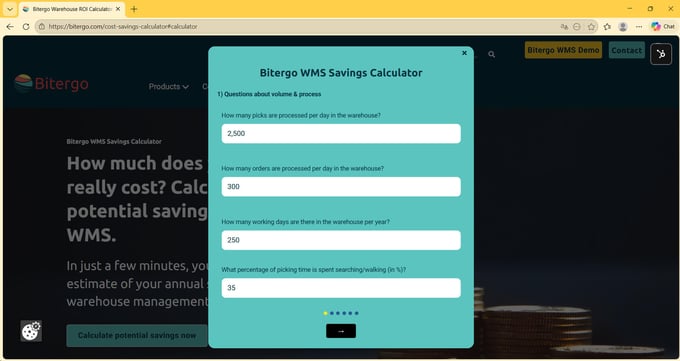
The Bitergo WMS Savings Calculator captures key volumes and cost drivers and translates them into savings and cash flows over multiple years. Typical levers include:
- Productivity gains in picking and order processing
- Quality costs due to mispicks, rework, and service effort
- Expedite costs and special transports as a result of unstable processes
- Returns and avoidable return shipments, including processing costs
- Capital tied up and safety stock, including cost of capital and storage costs
- Effort for onboarding new employees and process stabilization
- Operating costs of legacy systems in Information Technology, including maintenance and infrastructure
The result is a consistent, data-based hypothesis: under the entered conditions and the assumed effects of a Warehouse Management System, a specific savings potential and expected payback period emerge. After reaching payback, the effects continue, the one-time costs are covered, and the savings contribute as a lasting annual potential.
Methodology and Key Metrics of the WMS Savings Calculator
The logic is deliberately kept simple: introducing a Warehouse Management System generates recurring savings from productivity gains and quality improvements. After deducting ongoing system costs, the annual net benefit remains. From this, key performance indicators can be derived:
- Payback period: Time required for the one-time implementation costs to be offset by the annual net benefit
- Total Cost of Ownership: Total costs over the evaluation period, consisting of one-time costs as well as ongoing expenses for operations, licenses, and support
Link tip: The Bitergo “Guide to the Costs of Warehouse Management Systems” provides an overview of the initial and ongoing costs of a WMS
After reaching payback, the effects typically continue: the savings remain as a lasting potential and increase long-term competitiveness through more stable processes, better quality, and higher scalability.
Guidelines for effective Use of the WMS Savings Calculator
The quick ROI estimate becomes more meaningful and reliable when inputs are selected consistently and conservatively. Proven best practices include:
Use full operational Costs instead of ideal Values
Wages, error costs, and return costs should be calculated realistically, including internal effort and follow-up costs.
Compare WMS Scenarios instead of aiming for Pinpoint Precision
The true value lies in comparing conservative, base, and ambitious scenarios. The comparison shows how robust the business case is against different assumptions.
Focus on the largest Cost Drivers in the Warehouse
In many cases, only a few effects determine the overall benefit, such as productivity and error prevention. A precise discussion of the top levers delivers more value than optimizing minor variables.
Interpreting ROI Calculator Results and next Steps toward WMS Implementation
The WMS Savings Calculator provides an immediate online, data-based economic assessment of introducing a Warehouse Management System and makes the expected cost-saving potential in the warehouse transparent. As a quick estimate, the result is based on the assumptions entered. At the same time, the calculator captures the relevant inputs for a robust detailed analysis, such as pick volumes, mispicks, rework, expedite costs, returns, and staffing levels.
This makes the ROI calculator result an ideal starting point for a structured evaluation of introducing a Warehouse Management System and for preparing the next phase, in which assumptions are verified, process data validated, and implementation efforts planned realistically.
Quick ROI Check, in-depth Business Case: The Bitergo Calculator as a starting Point for your WMS Decision
Bitergo’s ROI calculator is available as an interactive tool on the website and immediately generates an initial return-on-investment estimate. The calculator can be used directly to gain quick insight into the economic viability of introducing a Warehouse Management System.
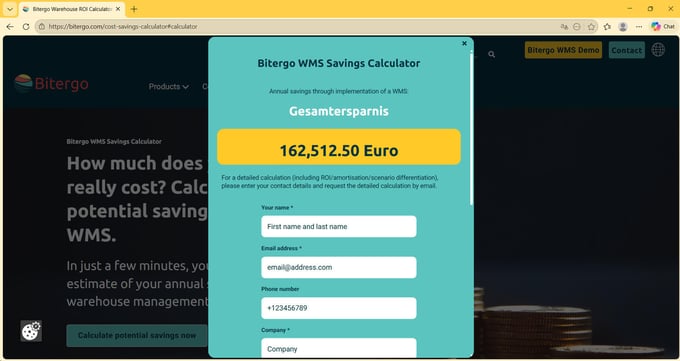
If you have questions about inputs, assumptions, or interpreting the results, the Bitergo Service team will be happy to assist and, upon request, provide a detailed analysis and consultation, including a finance-ready calculation report in PDF format.